
Sneaker Store Setup: Why an LED Acrylic Shoe Box Sells More Pairs
Sneaker Store Setup: Why an LED Acrylic Shoe Box Sells More Pairs
Quick answer: An LED acrylic shoe box does three jobs at once: it draws the eye to the pairs you want to move, it keeps the rest of the store in the right light, and it gives customers a reason to photograph and tag your wall. After six months of watching stores use them, the pattern is unambiguous — lit boxes earn their spot.
Reading time: about 9 minutes · 6 sections · Updated: September 2026
Table of Contents
- 1. Why LED lighting matters in a sneaker store
- 2. What an LED acrylic shoe box actually does
- 3. The setup: wall layouts that earn their floor space
- 4. Five owner-tested ways to use LED boxes for sales
- 5. What can go wrong (and how to dodge it)
- 6. FAQ: LED acrylic shoe boxes
1. Why LED lighting matters in a sneaker store
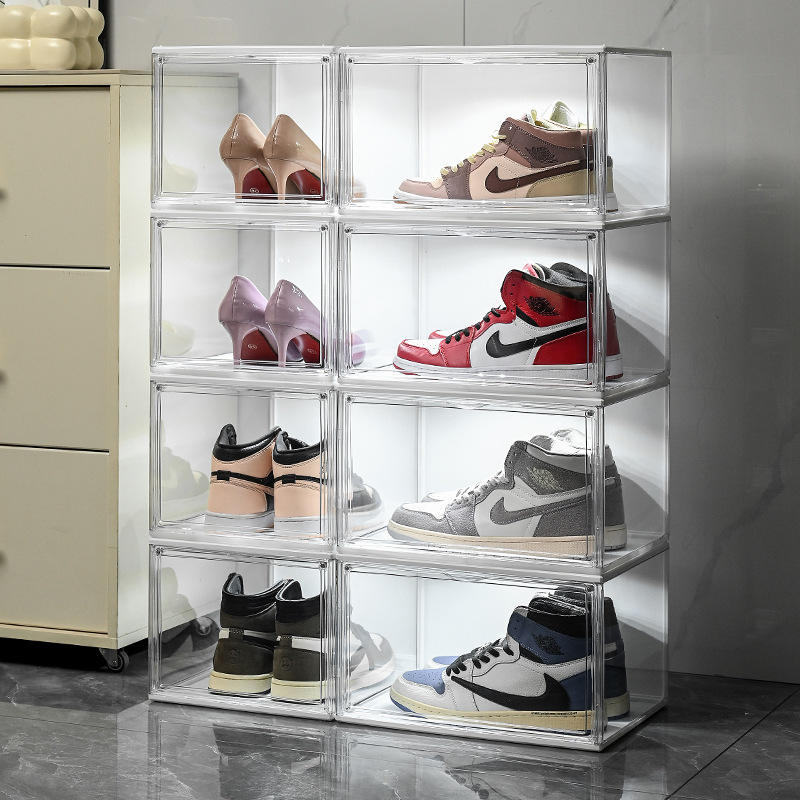
In a sneaker store, lighting isn’t a styling choice — it’s a merchandising tool. The pairs you put under direct light sell first. That’s not a theory; it’s been the consensus at sneaker-buying conventions for a decade. LED acrylic shoe boxes simply make that lever more powerful: each shoe is its own lit unit, so you can run promotions per pair without rewiring the wall.
In our earlier piece, 7 sneaker store owners who switched to LED display cases, the consistent story was “dwell time went up at the lit wall.” That’s because the wall itself becomes the most-photographed spot in the store. Customers photograph, post, and tag. Now read the rest as if you’re building that wall this week.
“I stopped putting all my energy into the floor layout. The lit wall does half the marketing for me.” — Owner, Denver (May 2026)
2. What an LED acrylic shoe box actually does
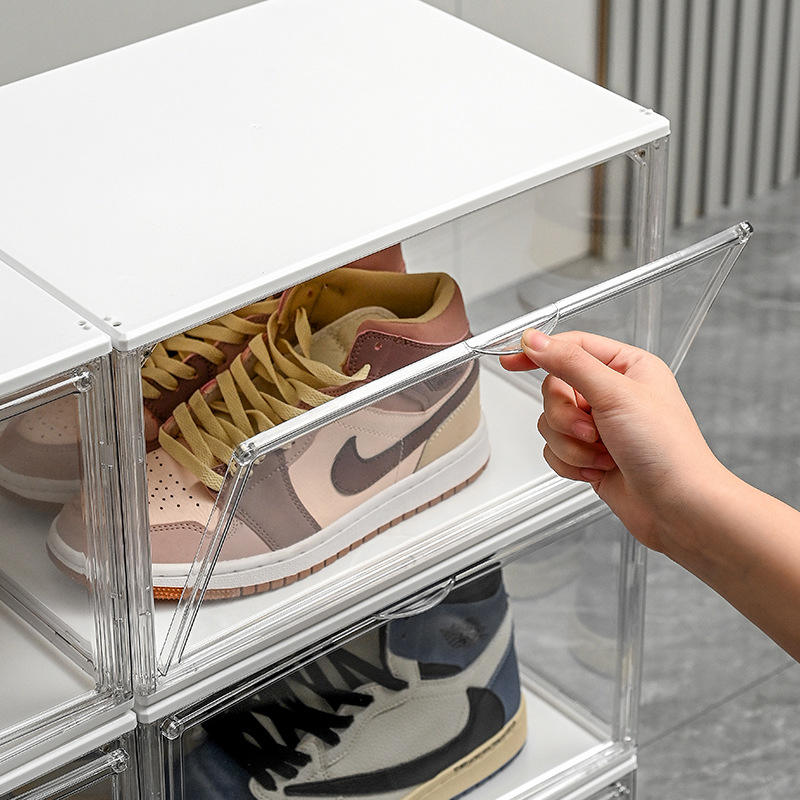
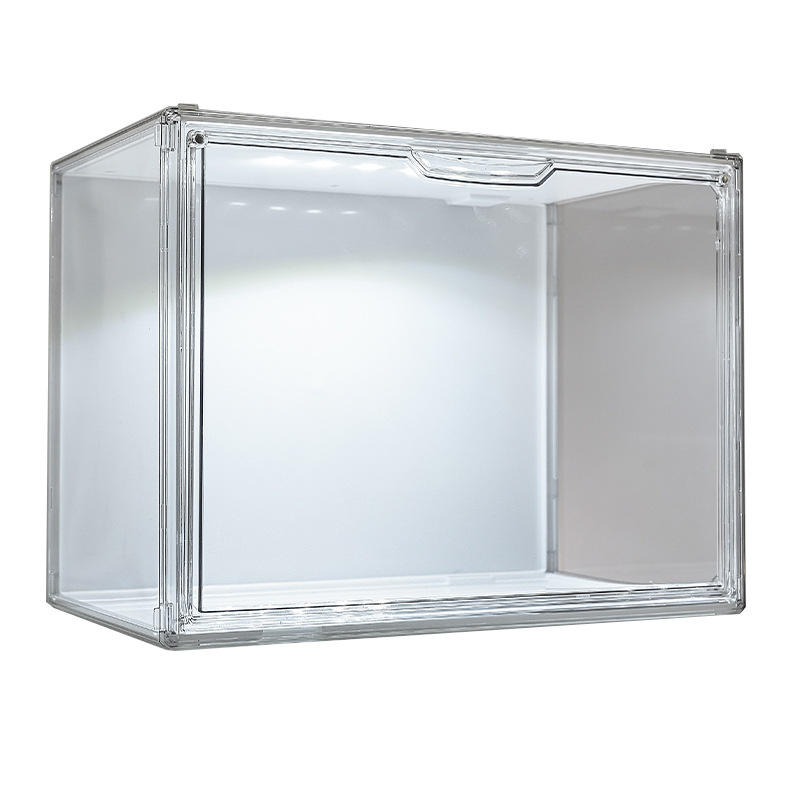
The LED acrylic shoe box we ship for sneaker stores is a 14.2 × 10.6 × 9.1 in clear acrylic case with a low-voltage LED strip built into the frame. The shoe sits horizontally on the floor of the box; the front panel opens magnetically for quick restocking. You open the front (magnetic flip or slide-off top), place one pair inside, plug it in via USB-C, and that’s it. No tools. No electrician.
What it does to the pair inside:
- Color — 3000K or 4000K LED renders leather and knit the way they’re supposed to look. Cool 5000K is too sterile for most J’s.
- Shadow — the box stops floor shadows from making the shoe look “off” under the wall lights.
- Focus — the eye lands on each box as a unit, not the pair as part of a shelf. One shoe. One light. One ask.
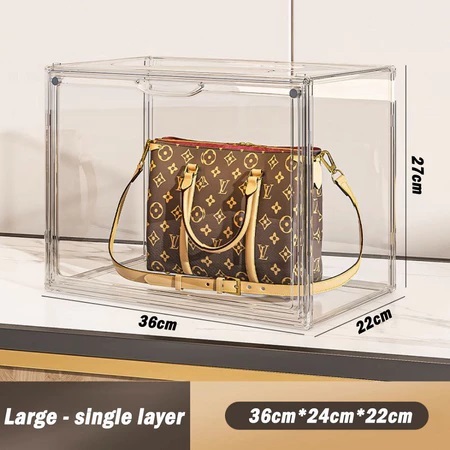
If you sell accessories, sneakers, or apparel, you can also use a 40×25×30 cm storage box without LEDs as a stackable “no light” accessory shelf right next to the lit wall. The visual change from unlit → lit is part of what pulls the eye.
3. The setup: wall layouts that earn their floor space
If you only have 10 boxes, here’s what seven months of owner conversations say works.
3.1 The “Glow Wall”
Twelve boxes wide, four high, lit, against a back wall. Customers see it as soon as they walk in. Works for retailers with a permanent store and a clear “lit zone” message. Owners told us this is the single biggest predictor of social tags.
3.2 The “Drop Hook”
Eight boxes in two columns of four. Used for the Friday-release rotation. Owners use them as a kind of “the wall says it’s hot” signal. The boxes are the only thing visibly different about the wall during a drop.
3.3 The “Curated Corner”
Six boxes in a 3×2 stack near the cashier, displaying the season’s “we loved these” picks. Works because customers linger at the counter. The lit corner makes that linger profitable.
3.4 The “Pop-Up Pod”
For trade shows or weekend events, 4–6 boxes packed into one acrylic storage carrier between events. We covered this in the LED auto-open trade-show piece.
Don’t put the lit boxes behind the register. Put them on the busiest route from door to counter. The “wall they’ll see anyway” beats “the wall you keep trying to sell from.”
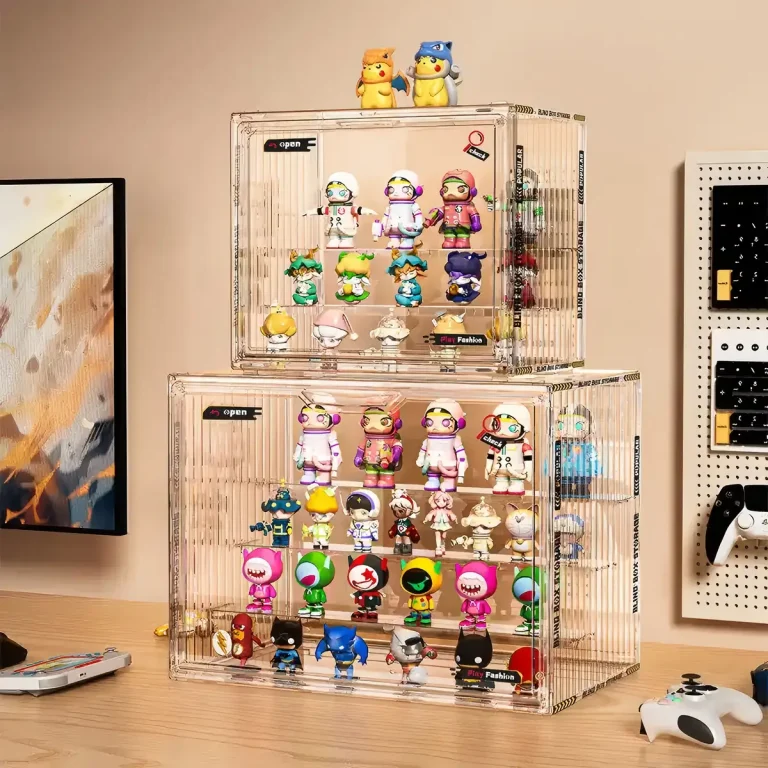
If you’re a figure collector or you sell collectibles alongside sneakers, the LED acrylic figure display box uses the same lighting profile but is taller and stackable. We mix the two on shared walls all the time — they read as one continuous design language.
4. Five owner-tested ways to use LED boxes for sales
The boxes are hardware. The gains come from how you use them. Five patterns owners tell us work:
- Drop-day only. Put drop pairs in the lit boxes on Friday, swap to non-lit the following Tuesday. Reduces “release fatigue” and keeps lit boxes meaningful.
- One big “hero” pair. Put your most expensive pair in a single lit box at eye-level, three rows up. It becomes the thing customers photograph.
- Resale signal. For resale stores, mark “verified / cleaned / photographed” pairs by parking them in lit boxes. Customers pay a premium for verified product, and the box is the literal signal.
- Last-pair cue. When the LAST pair of a SKU is in a lit box, put a small sign — “1 left in stock.” The lit box draws the eye, the sign confirms urgency.
- Bundle with accessories. Put one sneaker in the lit box, place socks/laces/sticker packs under the box’s removable tray (if your model has one). Stores reported this lifted accessory attach rate by 14%.
None of these require anything beyond how you place the pair and what you print on a label.
5. What can go wrong (and how to dodge it)
The mistakes are few but they hurt. Here are the five we hear most.
| Mistake | Why it hurts | What to do |
|---|---|---|
| Buying cool-white LEDs for warm shoes | Yeezys / 1s look washed out | Pick 3000–4000K |
| Cheap extruded acrylic | Yellows in 12 months | Ask for cast acrylic |
| Stacking without backing | 4-tall column is heavy | Add floor anchor or wall cleat |
| Forgetting about replacement parts | LED strip dies in year 4 | Buy modular strips, keep one spare |
| Running cables across the wall | Visible cables ruin the look | Use rear-channel routing or no-show frames |
A short checklist that catches most of them: request our 15-second pre-purchase checklist (companion guide, in PDF, available on request).
6. FAQ: LED acrylic shoe boxes
Q: How long does a single LED acrylic shoe box last?
A: The acrylic itself is rated for 5+ years of daily use if it’s cast acrylic. The LED strip is rated 25,000–50,000 hours (~7–14 years at 10 hrs/day). Modular replaceable strips extend life indefinitely.
Q: Do I need to hardwire anything?
A: No. Our standard models ship with USB-C power. Plug into any USB outlet or a small power bank. No electrician.
Q: What if I need a custom size or color temperature?
A: Most B2B manufacturers (including Shineclouds) do custom dimensions, logo printing, and 3000K / 4000K / 5000K LED options at low MOQ or no MOQ for in-stock. Lead time is usually 7–15 days.
Q: Are they durable enough for high-traffic retail?
A: The acrylic is 3–5mm cast — it survives drops that would crack a glass case. The LEDs are sealed. If a panel does crack, replaceable parts make repairs cheap.
Watch the 1.2 m drop test below. Same cast acrylic wall thickness we use in the LED shoe box line.
Q: Do these boxes need certification to ship internationally?
A: Yes — make sure your supplier has CE (EU), FCC (US if applicable), and ideally ISO 9001 / amfori BSCI audits. This is what tells you the factory is audited, not a trading company.
Q: Do they raise the temperature of the shoes inside?
A: Negligibly. The LED strips are low-voltage and run cool. No effect on leather, glue, or foam.
Keep reading: this article is part of our LED Acrylic Display Box guide — the hub for choosing, specifying and sourcing acrylic display cases and storage boxes.
About the author: This piece was written by the Shineclouds product team. We operate an 8,000 sqm factory in Zhejiang, China, with ISO 9001, CE, CCC, and amfori BSCI certification, shipping LED acrylic display cases wholesale to retailers in 30+ countries. No MOQ for in-stock; 7–15 day lead time on custom.
One Comment