I Made Every Mistake Setting Up My Sneaker Store—Here’s What I’d Do Differently
Spent $15K on my sneaker store fit-out and got it wrong. Here’s every mistake I made—so you don’t have to repeat them. Save your money. Read this first.
Last year I helped a friend review his new sneaker store fit-out drawings. I looked at the budget breakdown and said one thing:
“You’re spending 90% of your money on the wrong stuff.”
He didn’t believe me. Total fit-out was about 15,000.Breakdown:ceiling/lighting5K, display cases $2K (cheap glass ones). The rest went to flooring, signage, random decor.
I told him: “You spent the most on the thing customers notice least (ceiling), and the least on the thing that actually sells product (display cases).”
He ignored me. Went with his plan.
Three months after opening, he quietly tore out all his display cases and replaced them with LED acrylic ones. Today I’m sharing his mistake list—so you don’t write the same check he did.
Mistake #1: $5K on a Fancy Ceiling, But the Shoes Are Still in the Dark
His store has this “starry sky” LED ceiling. Looks cool in photos, I’ll give it that.
But here’s the problem: the lights are on the ceiling, the shoes are in the cases, 3 meters below. Those two things have nothing to do with each other.
Light travels down from 3 meters up, bounces around the room, and by the time it reaches the shoes, there’s basically nothing left. And the “starry sky” LEDs? Cold white 6500K. Makes everything look blue-ish and sad.
What he should have done:
Put the light next to the shoes, not 3 meters above them. LED acrylic cases have internal lighting—that’s “accent lighting,” not “ambient lighting.” Big difference. Huge.
Mistake #2: No Focal Point = Customers’ Eyes Are Everywhere (and Nowhere)
This is the deepest mistake, and the hardest to explain. Basic glass cases are just… boxes. Transparent boxes. Shoes sit inside and they’re just… there.
LED acrylic cases are different. Because the light is inside the case, the shoes are bright and everything else is darker. Your eye goes straight to the bright thing. That’s “visual hierarchy.” That’s a focal point.
After my buddy switched cases, he noticed something: customers spent longer at each case. Before, people skimmed past in 2 seconds. After, they’d stop, crouch down, look from different angles, sometimes take a photo.
Longer dwell time = higher conversion rate. Not psychology magic. Basic retail math.
Mistake #3: Forgetting That Customers Take Photos (Free Marketing!)
This is the most expensive mistake, because it’s not about money spent—it’s about money not earned.
Today, if you run a physical store (especially streetwear/sneakers), you have to think about one question: will customers take photos and post them?
If no—you’re paying for 100% of your traffic through rent, ads, footfall. Expensive.
If yes—you’ve got a free marketing channel you didn’t pay for.
After switching to LED acrylic cases, my buddy tracked this: before, maybe 3-5 people/month posted photos. After? 5-8 people/week.
Why? Because LED-lit sneakers photograph beautifully.
Try it yourself. Take a photo of a sneaker in a basic glass case vs. an LED acrylic case. Post both to your story. The LED one will get more likes. Guaranteed.
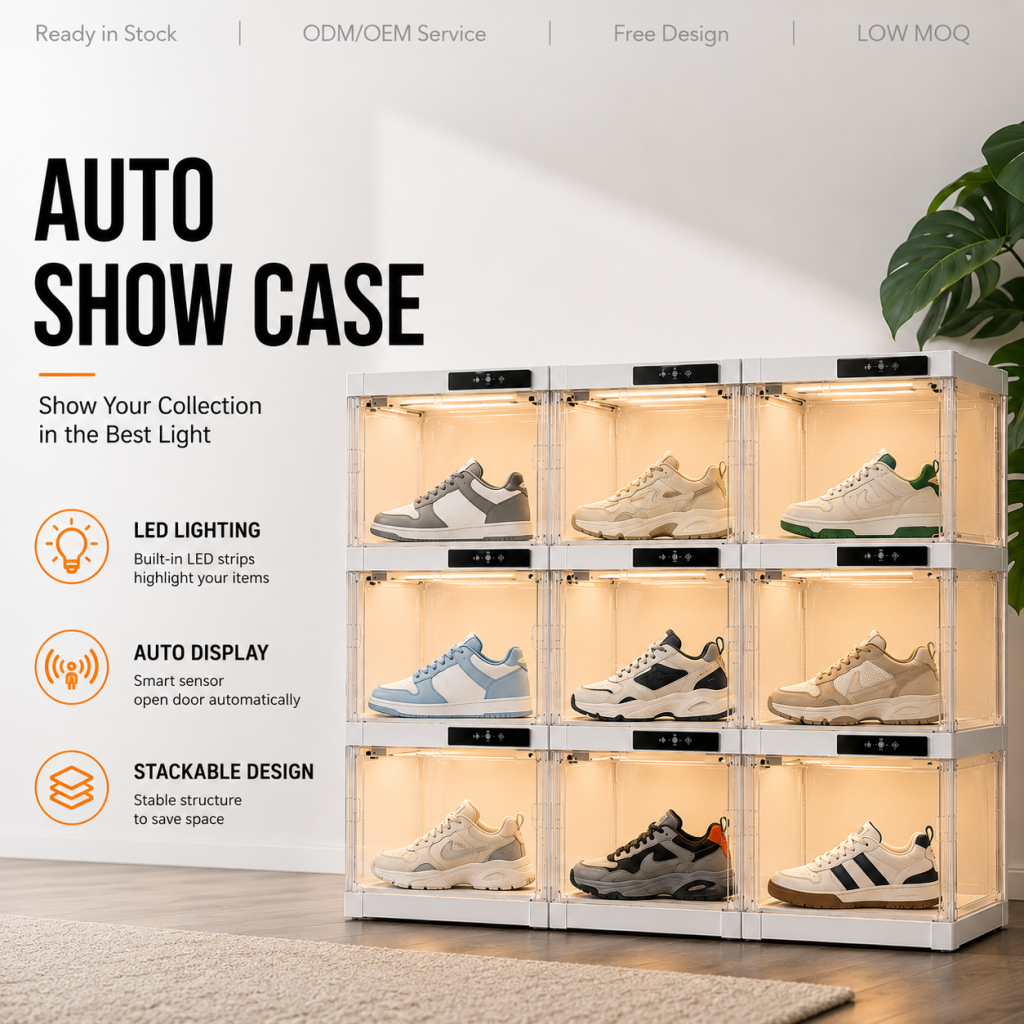
So How Do You Actually Choose the Right LED Acrylic Case? Real Talk.
Helped my buddy pick his replacement cases, learned a ton in the process. If you’re shopping, here’s what actually matters:
1. Light Color Temperature: 3000K-4000K. No Exceptions.
6500K = cold blue white. Makes skin look dead, makes sneakers look grey. 3000K = warm white, looks expensive, photographs beautifully. 4000K = neutral white, also fine. Just don’t do 6500K unless you’re lighting a parking garage.
2. Auto-Open: Electric Actuator, Not Gas Struts
Gas struts = “easier to lift.” Not auto-open. Real auto-open = electric actuator. Button press, lid goes up by itself. Whole different experience for the customer.
3. Acrylic Thickness: 3mm Minimum, 5mm Is Better
Thin acrylic warps and looks cheap. 5mm acrylic feels solid, looks premium, lasts years. Don’t cheap out here.
4. Size: Standard Shoe Box Is 36×26×15cm. Cases Need Clearance.
Don’t buy cases that are exactly shoebox size. You’ll regret it every time you try to take a box in/out. Internal dimensions should be at least 2-3cm larger on each side.
5. Customization: Logo, Size, Light Color—Just Ask
If you’re ordering 8-10+ cases, talk to a factory directly. Custom is often cheaper than buying retail, and you get your logo on the case. Brand building matters.
One More Thing: Don’t Wait Until After You Open
This is the most important advice I can give you.
If you’re still planning your store—decide on display cases now. Before you sign the lease. Before you approve the fit-out drawings.
Because if you open with bad cases, and then realize you need to change them, you’re paying for:
- The original cases (money gone)
- Removal and disposal (more money)
- New cases (the money you should’ve spent the first time)
- Lost time with your store looking half-finished (opportunity cost)
My buddy’s $2,100 “oops” could’ve been avoided with one conversation before he signed his contractor.
Final Word
Opening a sneaker store is expensive enough. Don’t make it more expensive by learning the same lessons the hard way.
Your store’s hero is your product. How you show it matters more than the product itself sometimes. Get the cases right, and everything else gets easier.
Need help figuring out what works for your space? Just reach out. We make these cases, we’ve done hundreds of stores, we can probably save you from a mistake or two.
Conclusion
Details win. Display cases seem small, but they affect how long people stay, whether they take photos, and whether they buy. My buddy tells everyone now: “Should’ve just done LED acrylic from day one. Would’ve saved me half a store’s worth of cash.”
Don’t be the person learning this the expensive way.