Blind Box Wall Display 101: How Retailers Are Doubling the Wow Factor
Blind Box Wall Display 101: How Retailers Are Doubling the Wow Factor
Quick answer: A blind box wall display done right lifts per-customer spend by roughly 2× — but only when you fix the height, the lit/unlit split, and the “open box” cue. Most retailer installs skip at least one of these, which is why most walls underperform. Here’s the install guide retailers share at trade shows.
Reading time: about 9 minutes · 6 sections · Updated: October 2026
Table of Contents
- 1. Why a blind box wall sells more than a shelf
- 2. The three things every working wall has
- 3. Choosing cases: wall-mounted vs counter vs floor
- 4. Lighting, color, and "loud" decisions
- 5. Mistakes that kill the wall
- 6. FAQ: blind box wall displays
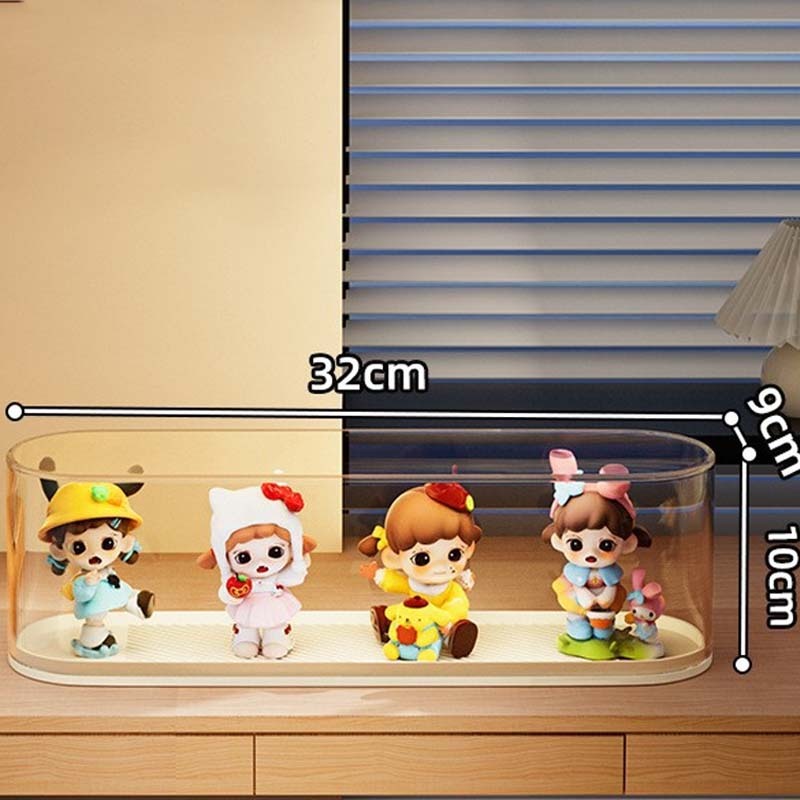
1. Why a blind box wall sells more than a shelf
There’s a reason collector stores, mall kiosks, and anime shops are doubling down on blind box wall displays instead of counter-top displays: the wall forces a browsing posture. You have to walk. You have to tilt your head. You have to stop, look up, look down. None of those things happen with a counter dump bin.
The data points we keep hearing from B2B retailers:
- Per-customer spend up 1.8×–2.4× vs. the same SKUs on a counter.
- Attach rate to “buy 3 get a deal” tier up significantly because the wall reads as a collection, not a single product.
- Customer photo-tagging increases because the wall is the most-photographed thing in the store.
This is the same dynamic we covered for 12-inch figure collectors — the room arranges the buying.
“We removed the counter display entirely. Now 80% of blind-box revenue comes off the wall.” — Manager, San Diego (June 2026)
2. The three things every working wall has
A working wall isn’t fancy. It’s just disciplined. Every retailer we spoke to said the same three things:
| Discipline | Why it matters |
|---|---|
| One pair, one box | If two boxes share the same lighting, they read as “the same thing.” Customers skip. |
| Eye-level for a STANDING viewer | That’s where customers spend 80% of their time. Below and above = below-the-fold. |
| 1 in 6 lit (max) | Lit boxes become the “new releases” signal. More lit = no signal. |
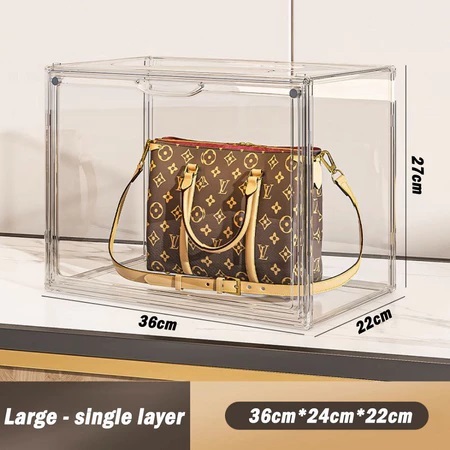
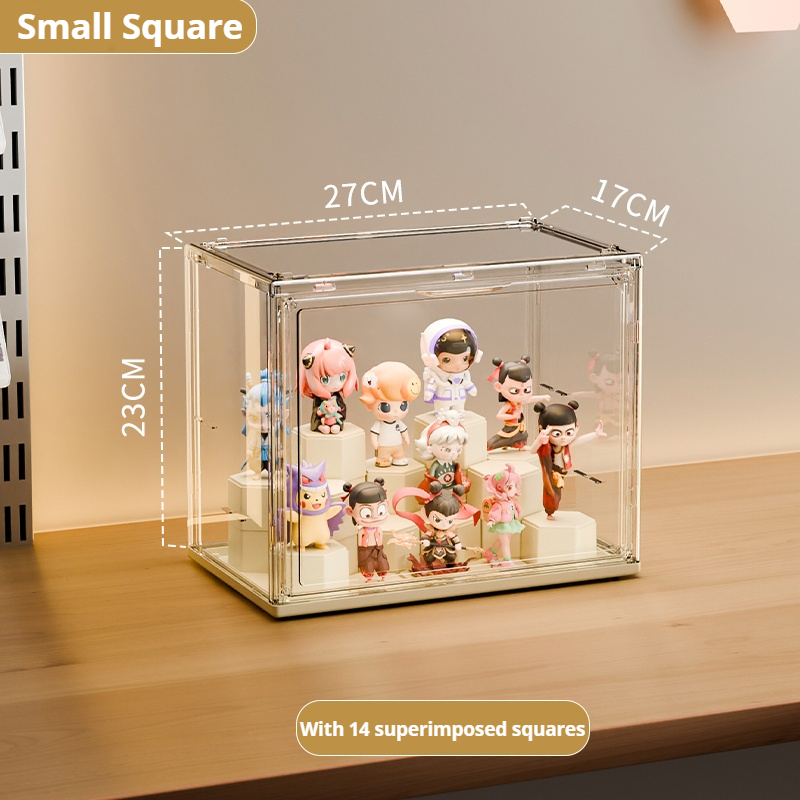
If you can’t enforce one-pair-one-box, your wall is just a shelf that costs more to install. The simplest fix is using wall-mounted acrylic blind box display boxes — one per SKU. The case is part of the unit, not part of the wall.
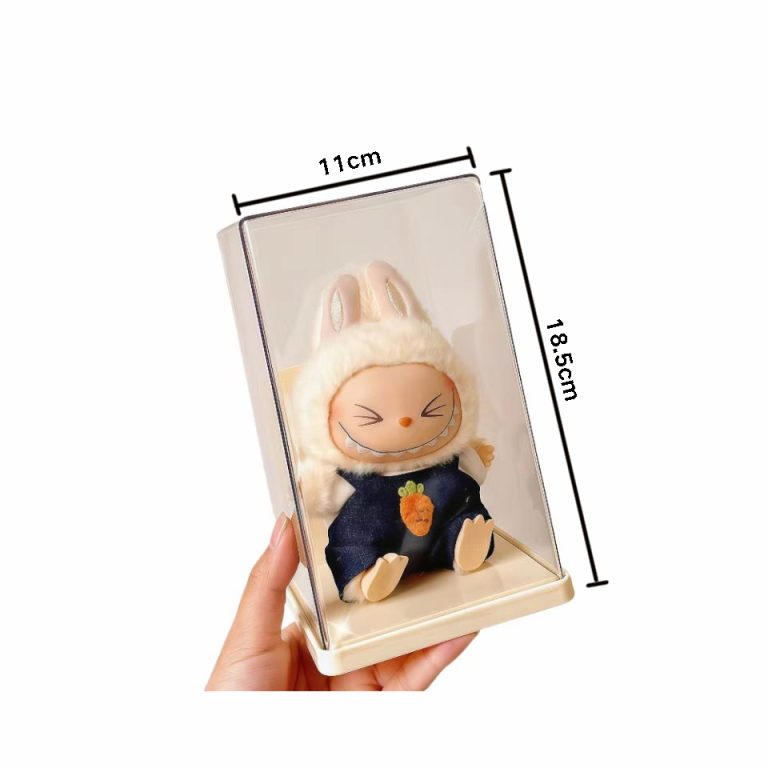
For “hero” SKUs (the ones you most want to move), drop in a lit figure case in the same family. Same DNA, different intent.
3. Choosing cases: wall-mounted vs counter vs floor
Three physical layouts work. Pick by floor space and foot traffic.
- Wall-mounted — boxes fixed to a vertical wall. Best for high-traffic stores with limited floor area. Each box must be replaceable; case costs typically < $20 per slot.
- Counter wall — boxes stacked on a counter against the back wall. Best for small boutiques; cheaper install but uses floor space.
- Floor standing — boxes hung from a freestanding frame. Best for pop-ups; the freestanding frame lets you rotate a wall into a back-of-store hallway.
Most retailers use wall-mounted as default and floor-standing for events. Counter-mounted is being phased out for new builds because floor space is too valuable.
Specs that matter
| Spec | Why |
|---|---|
| Acrylic thickness ≥ 3mm | Stops warping when the wall is in sun |
| Magnetic or slide-off front | Lets staff swap SKUs in under 10 seconds |
| Single-pair inner footprint | Stops customers putting two pairs in |
| Hidden cable channel | Visible cables ruin the wall |
We built our wall-mounted blind box display boxes to these specs as defaults. For multiple store locations or big installs, we do custom runs at low MOQ.
4. Lighting, color, and “loud” decisions
Two retailers look identical except for lighting. One of them sells 2× as much. The reason is rare-but-real: the lit boxes need to be rare, not common.
4.1 The 1-in-6 rule
For every 6 wall-mounted boxes, light one. The lit box is the “new” signal. If customers see all-lit, the signal is gone.
4.2 Color temperatures
Use 4000K neutral for the lit boxes. It flatters the typical blind-box palette (pastels, neons). 3000K makes pastels look muddy. 5000K makes them look like supermarket lighting.
4.3 What “loud” actually means
Loud in a wall display isn’t LEDs and neon. It’s contrast. Pick one of these contrast moves at a time:
- 2 wide × 8 tall vs. 4 wide × 4 tall — different rhythms; both work.
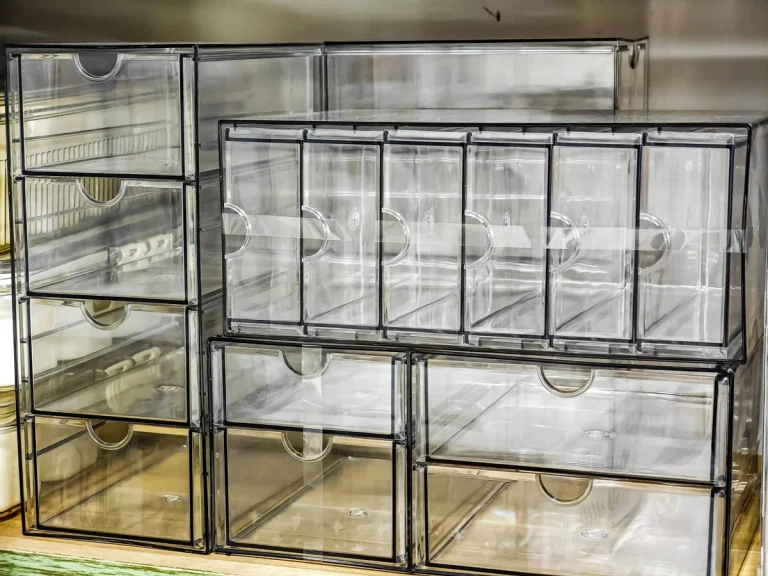
- Mixed sized cabinets — one double-wide slot for a “hero” SKU.
Once you’ve picked, stop fiddling. Customers need to learn the layout.
5. Mistakes that kill the wall
These come up over and over:
- Two SKUs per box. The case becomes a “duo” the customer thinks is a bundle. Treat every slot as one SKU.
- Lit all the time. “If everything is highlighted, nothing is.” Retail mantra.
- Wall at standing eye-level only. Top and bottom should also serve — top = new releases, bottom = under-$10 entry SKUs.
- Cases that fog. Cheap extruded acrylic fogs within a year. Cast acrylic stays clear.
- No restock plan. A wall with empty boxes is sad. Restock daily.
If your wall already lives in a dark store, lighting is the first move. If it’s in a sun-lit or well-lit store, lighting is decoration, and you should save the budget for a 40×25×30 storage wall under the display to keep backup boxes dry and dust-free.
6. FAQ: blind box wall displays
Q: How many cases do I need to start?
A: Most retailers start with 12 cases (3 wide × 4 tall) on one wall, then expand. 12 fits the budget, and the data is meaningful by week 4.
Q: Are wall-mounted acrylic display boxes safe in a public store?
A: Yes. Cast acrylic is 10× the impact resistance of glass, and the magnetic or slide-off fronts are tested to 30,000+ cycles.
Q: How long does installation take?
A: For 12 cases on a standard drywall, expect 2–3 hours with two staff. Most stores do it on a Sunday morning before opening.
Q: Can I add a logo or brand color?
A: Yes — most B2B factories (including Shineclouds) offer custom logo and color inserts at low MOQ for in-stock designs and 7–15 day lead time for custom.
Q: What if I want to rotate cases between stores?
A: Wall-mount kits and floor-standing frames are both designed for move-and-rebuild. With a label maker and 30 minutes, you can change the wall.
Q: Are these cases safe for international shipping?
A: Yes — acrylic cases survive parcel shipping without breakage if foam-cornered and double-boxed. Confirm your factory uses that packing. CE/ISO 9001 certification is the right baseline.
Keep reading: this article is part of our LED Acrylic Display Box guide — the hub for choosing, specifying and sourcing acrylic display cases and storage boxes.
About the author: This piece was written by the Shineclouds product team. We operate an 8,000 sqm factory in Zhejiang, China, with ISO 9001, CE, CCC, and amfori BSCI certification, shipping acrylic display cases wholesale to retailers in 30+ countries. No MOQ for in-stock; 7–15 day lead time on custom.