Where to Put Your 12-Inch Figures (And How a Display Case Earns Its Spot)
Where to Put Your 12-Inch Figures (And How a Display Case Earns Its Spot)
Quick answer: Most 12-inch figure owners put their collection wherever there’s shelf space — a bookshelf, a side table, a corner of the desk. That’s the wrong logic. Here’s the layout rule professional collectors and retailers use, plus which kind of acrylic figure display case earns its space and which one just looks pretty.
Reading time: about 10 minutes · 6 sections · Updated: October 2026
Table of Contents
- 1. The 3-spot rule for 12-inch figures
- 2. What's actually in a "good" display case
- 3. Sizes and when to choose each
- 4. Lighting: when it helps and when it hurts
- 5. The 4 collector-approved layouts
- 6. FAQ: acrylic figure display cases
1. The 3-spot rule for 12-inch figures
Professional collectors and retailers we work with rarely use more than three display spots in a room or store. Why three? Because once you have more, each spot stops feeling special, and any spot that isn’t special eventually stops being visited.
The three spots:
- Eye-level when sitting — most reading/lounging happens in a chair or sofa; that height is where a figure gets seen.
- Eye-level when standing — typically the lit wall of a store, or the “hero” wall at home.
- The “deliberate turn” — a spot the viewer doesn’t see unless they walk around. A floor pedestal near a turn. A shelf above a doorway.
“Once I moved my favorite 1/6 scale out of the corner and onto the stand near the door, I started seeing it three times a day. Three times a day I smile.” — Collector, Seattle (March 2026)
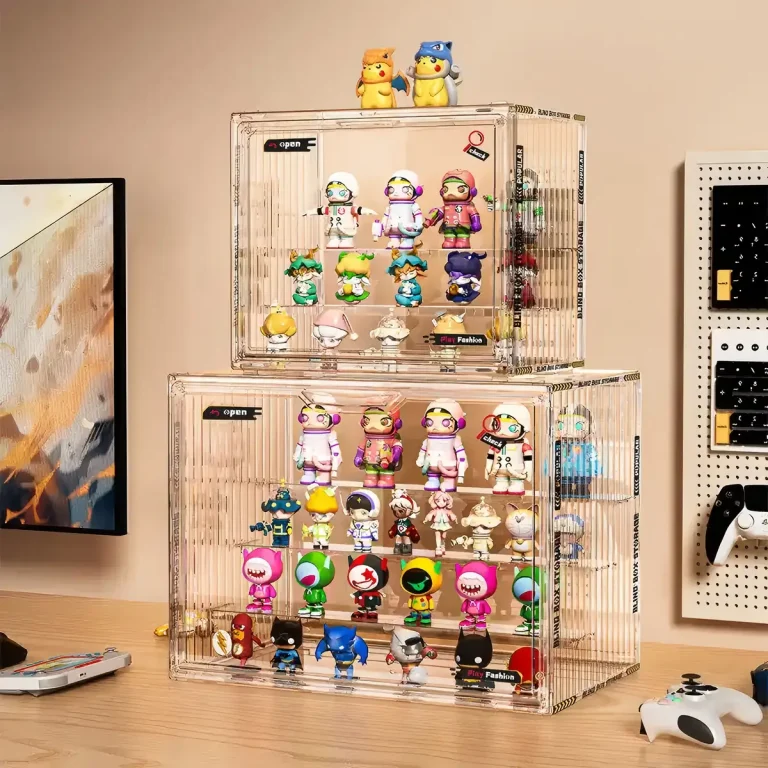
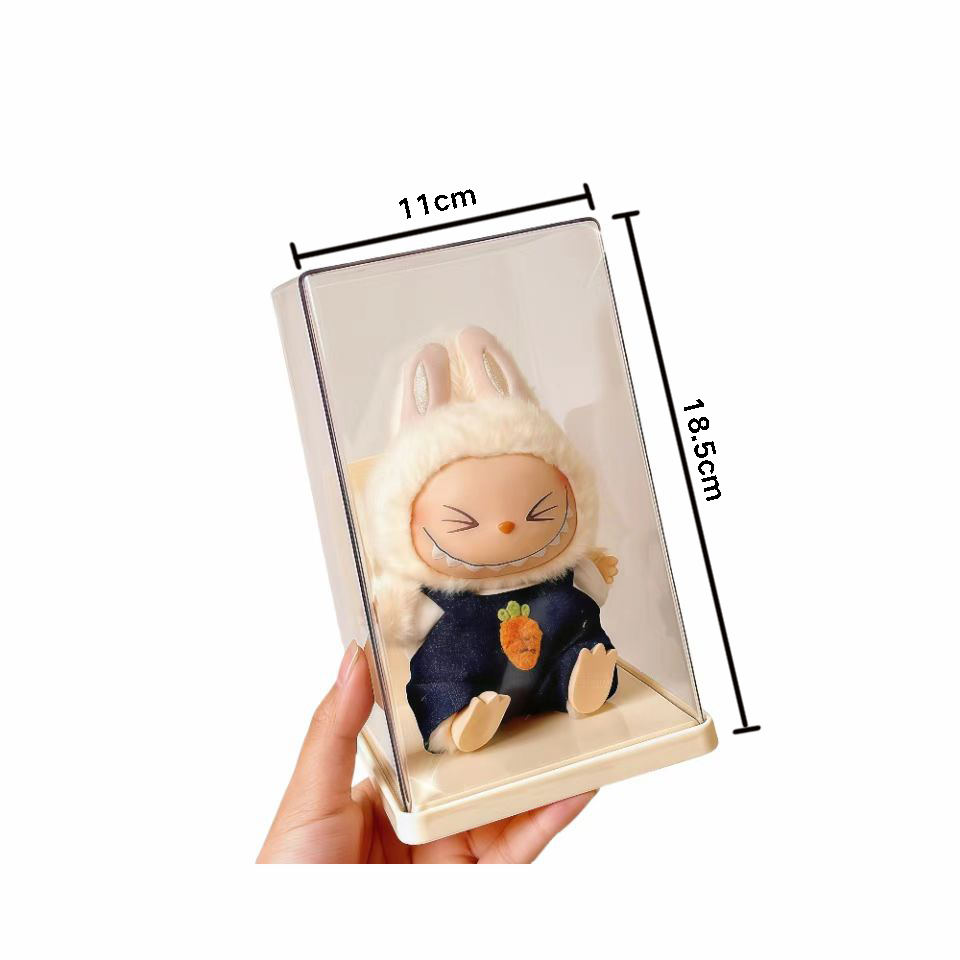
If a figure sits under eye level when sitting, you’re hiding it. If it’s mounted on a shelf above your sightline when standing, you’re hiding it. The fix is a sized acrylic case that lifts the figure up to the right height — or, in a store, a wall-mounted acrylic blind box display that brings the case down to the viewer’s height.
2. What’s actually in a “good” display case
Forget the marketing. A case has four jobs:
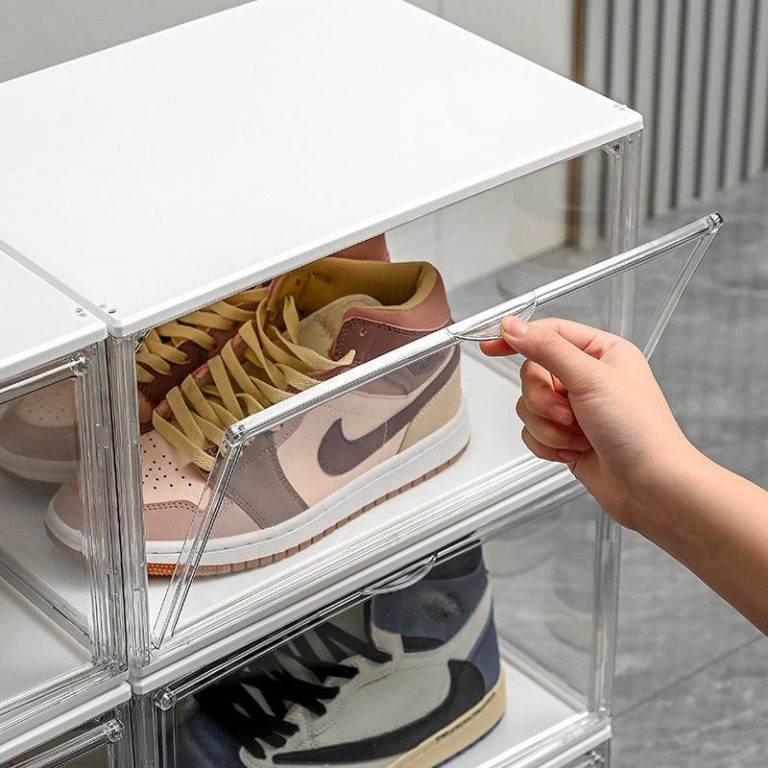
- Stop dust. No case earns its spot if dust gets in. Magnetic seal or compression fit is the key spec — friction-only is fine, but it has to be uniform.
- Stop UV. Acrylic blocks ~98% of UV. Glass is worse. If your figure is near a window, an acrylic case is non-negotiable.
- Survive a knock. 3mm cast acrylic is the minimum, 5mm if it’s a 12-incher on a high shelf.
- Look clean from every angle. No visible seams, no chrome trim reflecting the figure, no cables visible.
The materials side of this is in our PP vs PET vs PVC display box materials guide — same conversation, different chemistry angle.
3. Sizes and when to choose each
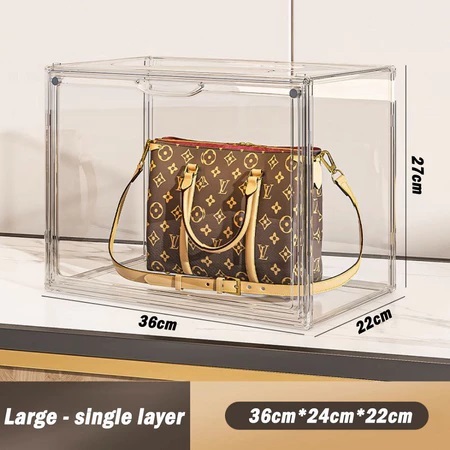
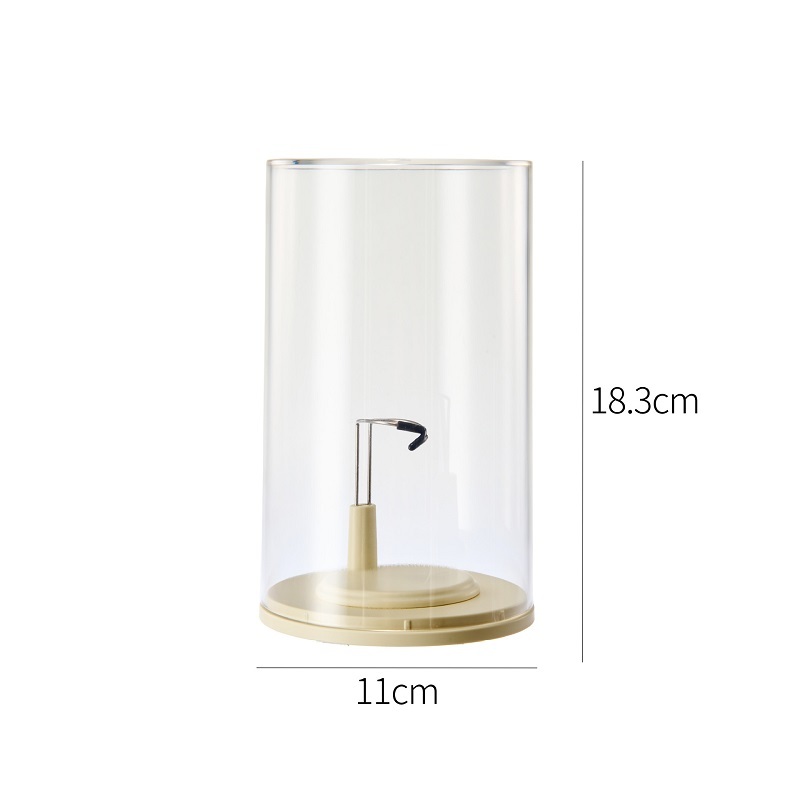
Most off-the-shelf cases in the U.S. market are sized for 1/6 scale (around 12 inches). 1/4 scale (18-inch) and 1/3 scale (22-inch) need a different category — the oversized acrylic display case.
| Figure size | Case size (typical inner) | What to look for |
|---|---|---|
| 1/6 (~12 in) | 11 × 6 × 5 in | Magnetic top, 3mm+ cast, optional LED |
| 1/4 (~18 in) | 16 × 9 × 9 in | Magnetic front access, internal base plate |
| 1/3 (~22 in) | 20 × 12 × 10 in | Floor-stand or reinforced shelf required |
If you’re a B2B buyer (resale shop, comic store, blind-box boutique), your customers buy mostly 1/6. Stock more of those. If your customers buy larger statues, stock the oversized cases and let the 1/6 fit on the empty shelves you have already.
Our collectors’ guide to choosing the right acrylic figure display case goes deeper on size-by-size, including gunpla and resin statue case sizing.
4. Lighting: when it helps and when it hurts
Three rules:
- Lit cases are for the “hero” wall, not the “library” wall. Putting LEDs on every case turns the room into a duty-free shop. Pick 2–3 lit cases per room/store; everything else should be unlit.
- Color temp matters more than brightness. 4000K is the safe default. 3000K makes warm figures (gold, browns) look richer; 5000K helps cool-toned resin (white, silver, blue).
- Diffusion, not direct light. A bare LED strip is cheap but ugly. A frosted acrylic insert or side-mounted strip looks like a museum — for almost the same cost.
If a figure faces bright window light already, skip the LED on that case. The window is the light.
5. The 4 collector-approved layouts
These come up over and over in collector meetups and inside our B2B retailer conversations. Pick one, then stop changing it.
Layout A — “The Salon’s End”
One hero case (1/4 scale or 1/3 scale) on a low cabinet at the end of the longest sightline in the room. Unlit. Two smaller cases flank it on the same cabinet, unlit. Total: 3 cases.
Layout B — “The Lit Corner”
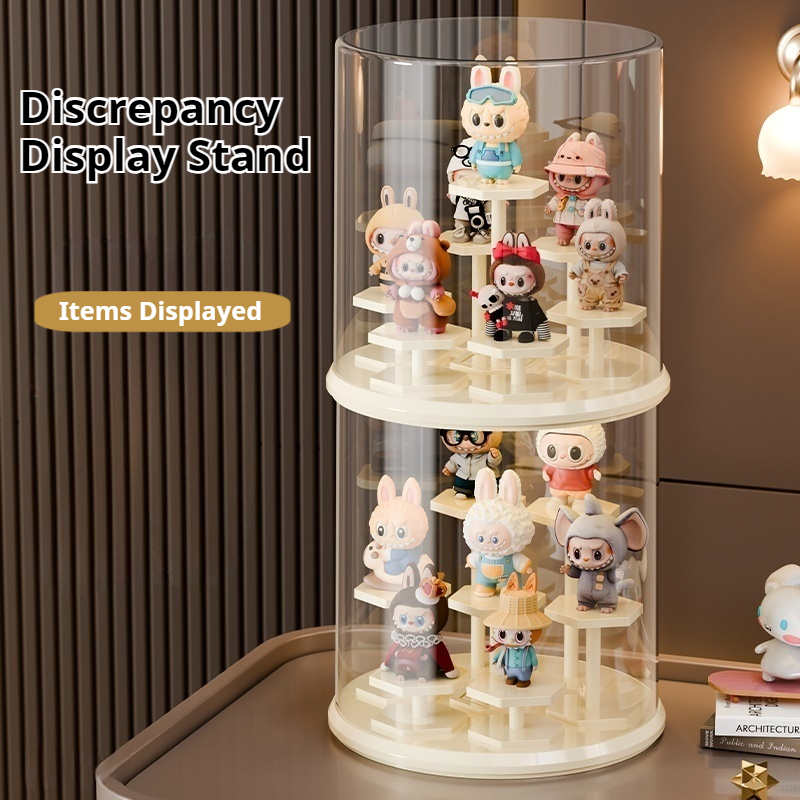
Three 1/6 cases in a vertical stack, all lit, in the corner nearest the entrance. The room’s most-photographed spot.
Layout C — “The Library”
Twenty-plus 1/6 cases stacked on a 6-tier shelf, none lit, all dust-sealed. This is the working wall — add or swap figures weekly without thinking about lighting.
Layout D — “The Show Wall”
Above a doorway or above a sofa, a row of 1/6 cases at standing eye-level, all unlit. Fun surprise when guests notice the wall.
In stores, Layouts B and C are the ones that ship revenue. Layouts A and D are the ones that ship photographs and tags.
6. FAQ: acrylic figure display cases
Q: Cast acrylic or glass — which is better for figures?
A: Cast acrylic. It blocks more UV, weighs less, and resists impact 10× better than glass. Glass scratches figure paint if it touches the case.
Q: Do I really need an LED on a figure display case?
A: Only if the figure is on a wall that doesn’t otherwise have light. Inside a normally lit room, an LED is decoration, not necessity.
Q: What’s the best material — PP, PET, PVC, or acrylic?
A: Pure PMMA cast acrylic is the top spec for clarity and UV blocking. PVC is cheaper, but it yellows in 2–3 years. PET is mid-tier. PP is rare in display cases. Full chemistry breakdown is in our material guide.
Q: What’s the right dust seal?
A: Magnetic top or compression-fit front panel. Friction-only is fine for sealed showcases but lets dust in over months.
Q: Are display cases stackable?
A: Yes for cast acrylic with a tongue-and-groove top. Avoid stacking glass. Avoid stacking PVC.
Q: Can I customize size, brand, or LED color?
A: Most B2B factories (including Shineclouds) do custom sizes and LED color temperatures at no MOQ for in-stock designs and 7–15 day lead time for custom.
Keep reading: this article is part of our LED Acrylic Display Box guide — the hub for choosing, specifying and sourcing acrylic display cases and storage boxes.
About the author: This piece was written by the Shineclouds product team. We operate an 8,000 sqm factory in Zhejiang, China, with ISO 9001, CE, CCC, and amfori BSCI certification, shipping acrylic display cases wholesale to retailers in 30+ countries. No MOQ for in-stock; 7–15 day lead time on custom.